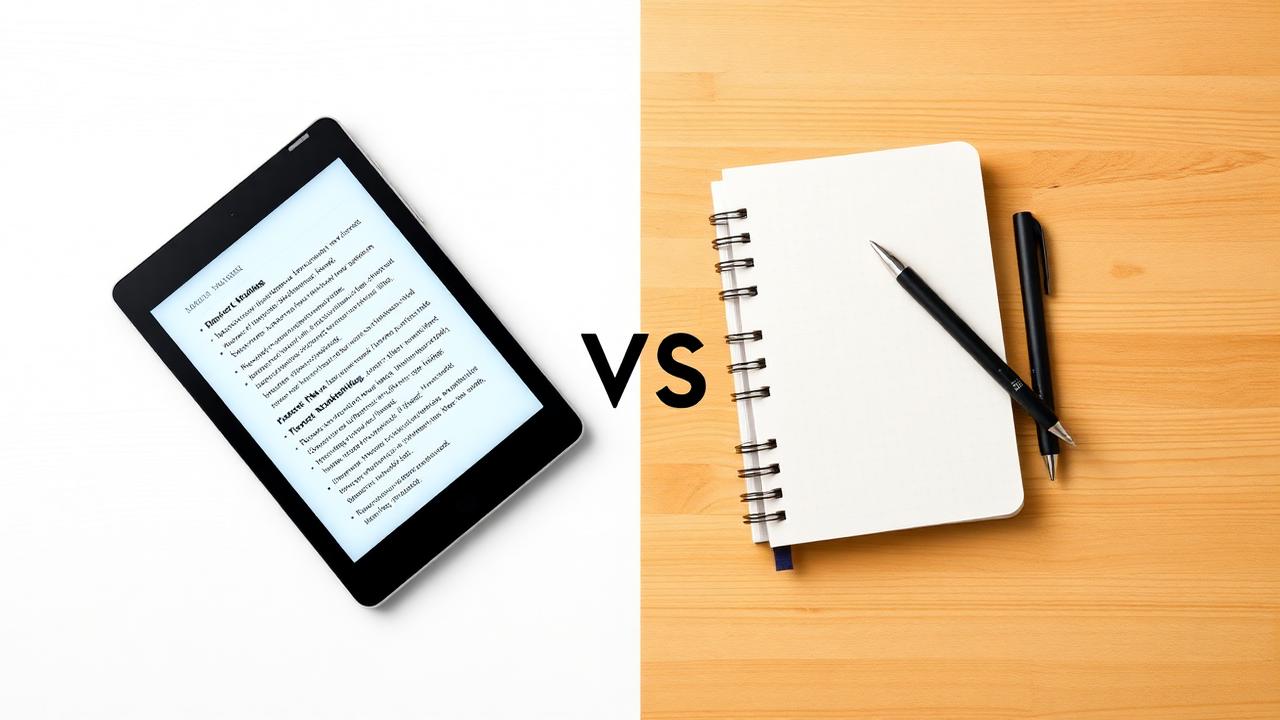
The digital vs paper debate continues in 2025. Both have passionate advocates. Let's examine the science, pros, cons, and help you decide.
The Science: What Research Shows
Paper Note-Taking Advantages (Scientific Evidence)
Better Retention: Mueller & Oppenheimer study (2014) shows handwriting beats typing for conceptual understanding. Students who handwrote notes scored 23% higher on conceptual questions.
Why? Motor memory (physical act strengthens neural pathways), slower pace forces processing (can't transcribe verbatim), fewer distractions (no notifications, no multitasking), spatial memory (remember location on page).
Deeper Processing: Handwriting activates more brain regions than typing. fMRI studies show increased activity in areas linked to: Learning, Memory, Language processing.
Better for Math & Diagrams: Freedom to draw anywhere, quick sketches and symbols, spatial relationships clear, no formatting constraints.
Digital Note-Taking Advantages (Scientific Evidence)
Better Organization: Instant search (find anything in seconds), tags and categories (multiple ways to organize), easy reorganization (move notes effortlessly), backup and sync (never lose notes).
Collaboration & Sharing: Real-time collaboration, easy sharing via link, version history, multimedia integration.
Accessibility & Searchability: Access from any device, full-text search, OCR for images, voice-to-text for speed.
Environmental & Practical: No paper waste, unlimited pages, easy editing and revision, copy/paste efficiency, multimedia notes (audio, video, images).
Detailed Comparison: 12 Key Factors
1. Retention & Learning
Winner: Paper (slight edge)
Paper: 23% better conceptual understanding, stronger motor memory, less distraction during capture. Digital: Review and spaced repetition easier, AI-generated quizzes, searchable for recall.
Verdict: Paper wins for initial learning. Digital wins for long-term review.
2. Speed of Capture
Winner: Digital (significantly)
Paper: 40 words per minute handwriting. Digital: 150+ words per minute typing, 200 words per minute voice notes, instant recording of audio/video.
Verdict: Digital is 3-5x faster.
3. Organization
Winner: Digital (overwhelmingly)
Paper: Physical filing, limited by space, hard to reorganize, no search. Digital: Folders and tags, instant search, AI auto-categorization, unlimited storage.
Verdict: Digital dominates organization.
4. Searchability
Winner: Digital (no contest)
Paper: Manual searching, time-consuming, easy to lose, no full-text search. Digital: Search any word instantly, search across thousands of notes, find by date/tag/category.
Verdict: Digital wins decisively.
5. Cost
Winner: Digital (long-term)
Paper: Notebooks $5-15 each, pens $2-10, highlighters, storage space, photocopying. Annual cost: $50-150.
Digital: App subscription $0-120/year, device you already own, unlimited notes. Annual cost: $0-120.
Verdict: Digital cheaper over time (plus environmental savings).
6. Flexibility & Editing
Winner: Digital (clearly)
Paper: Messy corrections, no rearranging, rewriting to reorganize, permanent mistakes. Digital: Easy editing, cut/paste, reorganize instantly, templates, version history.
Verdict: Digital far more flexible.
7. Backup & Durability
Winner: Digital (if backed up)
Paper: Physical damage risk, loss/theft risk, degradation over time, disaster vulnerability. Digital: Cloud backup (never lose), automatic sync, version history, encrypted security.
Verdict: Digital wins IF you backup regularly. Paper wins if you don't trust cloud.
8. Math & Diagrams
Winner: Paper (currently)
Paper: Draw anywhere freely, quick sketches, spatial freedom, natural flow. Digital: Improving with stylus, but still constrained, equation editors clunky, less natural feel.
Verdict: Paper better for math-heavy subjects (though gap closing with iPad + Apple Pencil).
9. Distraction Potential
Winner: Paper (focus)
Paper: No notifications, no internet rabbit holes, forced focus, single-purpose tool. Digital: Notifications tempting, browser tabs distracting, social media pull, multitasking temptation.
Verdict: Paper better for focus (but digital can match with discipline).
10. Accessibility
Winner: Digital (anywhere access)
Paper: Must carry notebooks, single physical copy, location-dependent. Digital: Access from any device, phone/tablet/laptop, offline mode available, sync across devices.
Verdict: Digital wins for convenience.
11. Collaboration
Winner: Digital (no contest)
Paper: Photocopying required, no real-time sharing, version confusion, merge issues. Digital: Real-time collaboration, easy sharing, comments and mentions, version control.
Verdict: Digital dominates collaboration.
12. AI Enhancement
Winner: Digital (obviously)
Paper: No AI possible. Digital: Auto-summarization, smart categorization, AI chat about notes, quiz generation, pattern detection, voice transcription.
Verdict: Digital unlocks AI superpowers.
The Verdict: Which Should You Choose?
Choose Paper If:
- Studying complex conceptual material
- Taking math or science with many diagrams
- Prone to digital distraction
- Value tactile experience
- In exam requiring handwriting
- Enjoy physical ritual of writing
Choose Digital If:
- Need to organize many notes
- Want searchability
- Collaborate with others
- Travel frequently
- Value speed over ritual
- Want AI assistance
- Care about environment
Choose Hybrid If:
- Want best of both worlds
- Different needs for different contexts
- Willing to manage both systems
The Hybrid Approach (Best of Both)
Many top performers use hybrid strategy:
Phase 1 - Capture (Paper): Handwrite during lectures/meetings for better retention, focus without digital distraction, draw diagrams freely.
Phase 2 - Digitize (Digital): Scan or photograph notes (apps like Luma can OCR), enhance with AI summaries, organize digitally, add tags and context.
Phase 3 - Review (Digital): Use spaced repetition apps, AI-generated quizzes, search across all notes, share as needed.
Best Tools for Hybrid:
- Luma (scan paper notes, OCR, AI enhancement)
- iPad + Apple Pencil (handwrite feeling, digital benefits)
- Rocketbook (reusable notebook, cloud upload)
- Microsoft Lens (scan to cloud)
Recommendations by Use Case
University Students: Hybrid - Paper for lectures (better retention), Digital for review and organization
High School Students: Paper for STEM subjects, Digital for humanities and group projects
Professionals: Digital (speed, searchability, collaboration)
Researchers: Hybrid - Paper for reading/annotations, Digital for synthesis and writing
Creatives: Paper for brainstorming, Digital for organization and execution
Lifelong Learners: Digital (lifetime knowledge base)
The Future (2025-2030)
Gap is closing: E-ink tablets improving, stylus tech getting better, AI making digital more powerful, AR/VR bringing tactile to digital.
Future prediction: By 2030, digital with stylus + haptic feedback may match or exceed paper for retention while keeping digital benefits.
Bottom Line
There's no universal winner. Best choice depends on your specific needs, learning style, and context.
For most people in 2025: Start digital (Luma) for 90% of notes, keep paper for complex learning or math.
Why? Digital benefits (search, organization, AI) outweigh paper's retention advantage for most use cases. Exception: Studying for crucial exams or learning deeply complex material - use paper.
Don't let tool debates stop you from note-taking. Taking notes (any method) beats not taking notes. Start now, refine later.
Luma Editorial Team
• EditorialLuma's editorial team researches and writes these guides based on publicly available information, hands-on use of Luma and other apps, and reader feedback. Articles are reviewed and updated periodically to keep pricing and features accurate.
Ready to Apply These Tips?
Luma turns the notes you write into a summary and flashcards. The free plan is permanent — no card needed.
Related Articles

How to Take Better Notes: Science-Backed Strategies for 2025
Master the art of note-taking with proven strategies backed by cognitive science. Learn active recall, spaced repetition, and effective review techniques.
Best Note-Taking Apps for College Students 2025 (Free & Paid)
Compare the top note-taking apps for college students in 2025. See pricing, features, and which app saves you the most money while boosting productivity.
Notion vs Luma for Students: Which is Better? (Save $84/year)
Detailed comparison of Notion vs Luma for college students. See features, pricing, and why 73% of students prefer Luma. Includes real student reviews.
Best AI Digital Notebook Apps 2025: Luma vs Notion AI vs Mem
Complete comparison of the best AI digital notebook apps for 2025. See features, pricing, and which AI notebook is right for you.