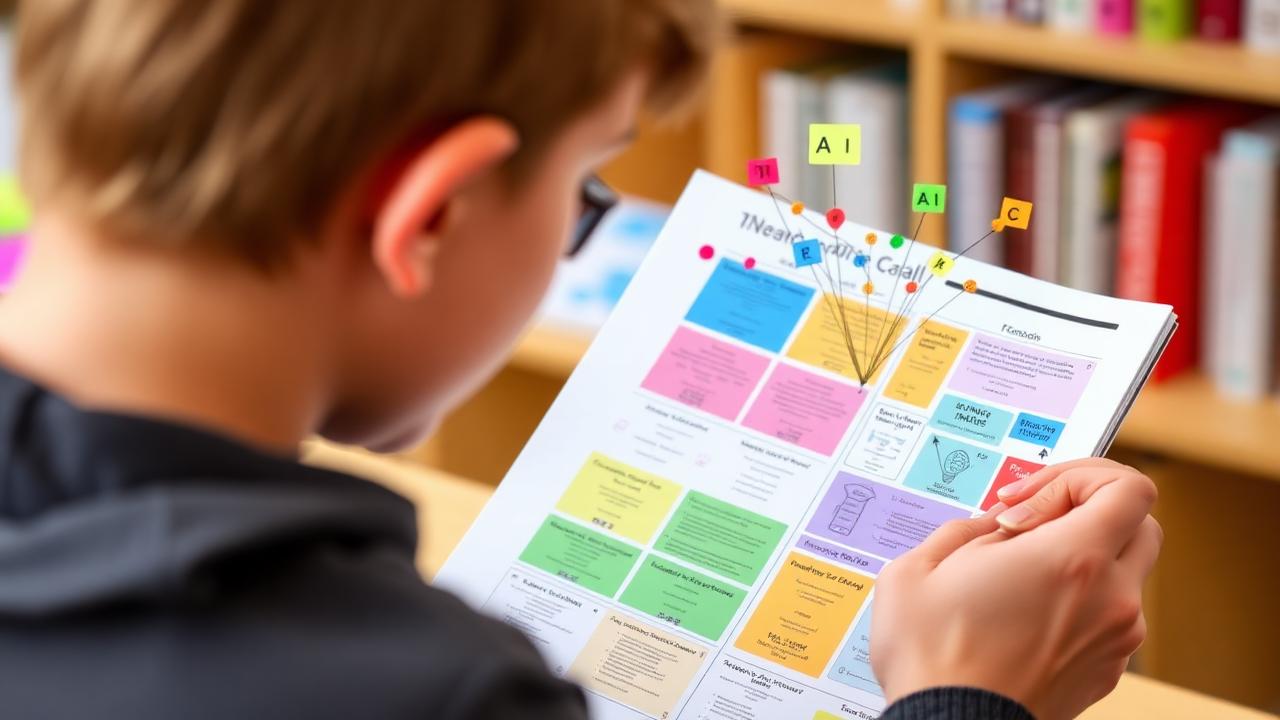
Most students take notes wrong. They create beautiful, comprehensive notes - and remember nothing. Here's how to take study notes that actually improve memory retention, backed by cognitive science research.
THE SCIENCE OF MEMORY
Your brain has three memory stages: Encoding (information goes in), Consolidation (information is processed), Retrieval (information comes out). Most students focus only on encoding. But retrieval practice is what creates long-term memory.
The Testing Effect: Testing yourself is more effective than re-reading. The Generation Effect: Creating information (not just consuming) improves retention. The Spacing Effect: Distributed practice beats cramming every time.
METHOD 1: ACTIVE RECALL NOTES
Instead of: Copying lectures word-for-word. Do this: Write questions during lecture, answer later. Turn every concept into a question. Leave space for answers, fill in from memory later.
Why it works: Retrieval practice strengthens memory. Question format naturally tests understanding. Identifies gaps in knowledge immediately.
Example transformation: Before: "Mitochondria is the powerhouse of the cell." After: "Q: What organelle is called the powerhouse of the cell and why? A: [fill in from memory]"
METHOD 2: SPACED REPETITION NOTES
Review schedule: Day 1 (take notes), Day 2 (review and test yourself), Day 7 (review again), Day 30 (final review). Each review should be from memory first, then check notes.
Why it works: Spacing fights the forgetting curve. Each retrieval strengthens the memory trace. Optimal timing maximizes retention with minimal effort.
Implementation: Date your notes, set calendar reminders for reviews, use apps with built-in spaced repetition, track which concepts need more review.
METHOD 3: ELABORATIVE INTERROGATION
For every fact, ask: Why is this true? How does this connect to what I know? What's an example? What's a counterexample? What would happen if this weren't true?
Why it works: Deep processing creates stronger memories. Connections provide multiple retrieval paths. Understanding beats memorization.
Example: Fact: "World War 1 started in 1914." Elaboration: "Why then? → Assassination of Franz Ferdinand → Why did that trigger war? → Alliance systems → How did those form? → Imperial competition → What were they competing for? → Colonies and resources."
METHOD 4: DUAL CODING
Combine words AND visuals: Sketch concepts, create mind maps, use color coding, draw diagrams, make flowcharts, add images.
Why it works: Verbal and visual memory are separate systems. Using both doubles your retrieval paths. Visual memory is often stronger than verbal.
Best for: Processes (flowcharts), relationships (concept maps), hierarchies (tree diagrams), sequences (timelines), comparisons (tables).
METHOD 5: THE FEYNMAN TECHNIQUE
Process: Choose a concept, explain it in simple terms (as if teaching a 10-year-old), identify gaps where you can't explain simply, review material to fill gaps, simplify explanation further.
Why it works: Teaching forces retrieval and organization. Simplification reveals true understanding. Gaps become obvious.
Pro tip: Write your explanation as notes. Use voice recording if writing is slow. Explain out loud while walking.
METHOD 6: THE CORNELL SYSTEM (ENHANCED)
Original Cornell: Divide page into three sections (notes, cues, summary). Modern enhancement: Notes section = concepts and details. Cues section = questions for active recall. Summary = your explanation in own words.
Add: Color coding for importance, mind maps for connections, review dates, confidence ratings.
Why it works: Built-in active recall structure, summary forces consolidation, cues enable self-testing, organization reduces cognitive load.
METHOD 7: INTERLEAVING PRACTICE
Instead of: Studying one topic completely before moving to next. Do this: Mix topics in your notes and review. Jump between subjects. Connect related ideas.
Why it works: Brain learns to discriminate between concepts. Mimics how you'll need to use knowledge. Improves transfer to new problems.
Example: Study 20 min biology → 20 min chemistry → 20 min biology (new topic) → 20 min chemistry (review).
PRACTICAL IMPLEMENTATION
During Lecture: Focus on understanding, not transcribing. Note key concepts and questions. Use abbreviations and symbols. Leave gaps to fill later.
Within 24 Hours: Review notes, fill gaps from memory, create questions for active recall, reorganize for clarity, add visuals.
Weekly Review: Test yourself using questions, explain concepts out loud, identify weak areas, create connections between topics, update notes with new insights.
Before Exams: Practice retrieval (not re-reading), solve problems from memory, teach concepts to others, simulate test conditions, focus on gaps.
DIGITAL vs HANDWRITTEN
Research shows: Handwritten notes improve retention (slower = deeper processing). Digital notes allow easier reorganization. Voice notes capture more during lecture.
Best approach: Take quick digital/voice notes during lecture, review and create handwritten active recall notes within 24 hours, use digital for spaced repetition reminders and AI quiz generation.
COMMON MISTAKES TO AVOID
Mistake: Beautiful, comprehensive notes (that you never review). Fix: Simple notes + active retrieval practice.
Mistake: Highlighting and re-reading. Fix: Self-testing and recall.
Mistake: Cramming before exams. Fix: Spaced repetition from day one.
Mistake: Passive note-taking (copying slides). Fix: Active engagement (questions, connections, examples).
Mistake: Not testing yourself. Fix: Make testing the core activity.
YOUR STUDY NOTES SYSTEM
Week 1: Implement active recall notes (turn everything into questions). Week 2: Add spaced repetition schedule (review on Day 1, 2, 7, 30). Week 3: Include elaborative interrogation (ask why for every fact). Week 4: Add dual coding (visuals + words).
Maintain: Weekly review sessions, self-testing before reading answers, teach concepts to others, track confidence levels, adjust based on actual exam performance.
Remember: Notes are not the goal. Memory is the goal. The best notes are the ones that make retrieval practice easy and effective. Start implementing these methods today, and watch your retention skyrocket.
Modern tools like Luma make this easier with AI-generated quiz questions from your notes, spaced repetition reminders, and active recall templates.
Luma Editorial Team
• EditorialLuma's editorial team researches and writes these guides based on publicly available information, hands-on use of Luma and other apps, and reader feedback. Articles are reviewed and updated periodically to keep pricing and features accurate.
Ready to Apply These Tips?
Luma turns the notes you write into a summary and flashcards. The free plan is permanent — no card needed.
Related Articles

College Note-Taking: From Lectures to A+ Grades
Master college-level note-taking with proven strategies for lectures, textbooks, and study sessions. Turn your notes into your most powerful study tool.
Cornell Notes Method in 2026: Templates, Examples & Digital Apps
Learn the Cornell note-taking method with printable templates, real examples, and the best digital apps for Cornell notes on laptop or iPad in 2026.
Digital Notes vs Paper Notes: The Science-Based Verdict
Should you take notes on paper or digitally? We analyze 15+ research studies on memory, retention, and learning to give you a definitive answer.

How to Take Better Notes: Science-Backed Strategies for 2025
Master the art of note-taking with proven strategies backed by cognitive science. Learn active recall, spaced repetition, and effective review techniques.